

Does The Internet Bring Us Together Or Draw Us Apart?

 he Internet has the unique power to connect any user with any other user, co-ordinate to any quality possible — relationships, beliefs, viewpoints, goals, bug, identity, or interests. For example, using e-mail and chatting software, connecting with family unit and friends who are far abroad geographically is cheaper and easier than calling or writing letters. Using a combination of the World Wide Web, chatting software, electronic mail, and give-and-take groups, minority groups that may accept been ignored past traditional media accept come up together online to share information, support each other, and organize events.
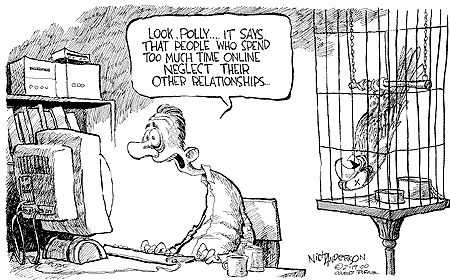
However, critics of the Internet believe that Internet utilise, while connecting more people virtually, makes people more isolated socially because the more than time they spend online, the less fourth dimension they spend interacting in real life. They believe that electronic communication is not every bit in-depth or reliable equally communication in person or on the telephone. Critics likewise see a possibility of the Internet breaking people apart into minority groups, as a consequence of less dependence on mainstream media, a phenomenon known as "balkanization."
Critical forecasts of the futurity of the Internet, for example in the movie The Internet, evidence people whose only friends are online buddies, whose real names are not even known. In these distopian worlds, social relationships are not even based on reality, but on the façades of other online users, whose bearding interactions tin be untruthful and unreliable. These people work from home, then at that place is no interaction with fellow employees, and their social lives are mingled with their work, which both revolve around the Net. These distopian views are countered past utopian views of a global village, where anyone can attain out to anyone else and geographic barriers are nonexistent, considering the Internet allows users to be always connected.
The 2 opposing viewpoints near the Net accept been debated extensively in the past few years, in role because several studies have recently emerged to support the viewpoint that Internet use has a negative effect on personal lives. These studies concluded that, among other things, the more time people spend on the Cyberspace, the less they collaborate with family and friends physically and over the telephone, the smaller their social circles become, and the more than they experience depressed. The survey methods take been heavily criticized and several other studies dispute their conclusions. Every bit society speedily approaches full Internet integration, it is important to consider the consequences of being connected near, and whether it is worth the risk of becoming asunder physically.

Source: https://cs.stanford.edu/people/eroberts/cs181/projects/personal-lives/debate.html
Posted by: spiveystootherents.blogspot.com
0 Response to "Does The Internet Bring Us Together Or Draw Us Apart?"
Post a Comment